What brand strategy is actually supposed to do for you
Most brand problems don't get solved by adding more. More channels, more content, more product innovation, and more tactics don't fix a shaky foundation. The real problem is usually underneath all of it: too much happening without enough shared understanding of why any of it is happening.
Clarity is table stakes foundation for telling your brand story and convincing people to buy.
Getting clear is the move. It sounds simple because it is, and it is also the hardest thing to do from the inside.
Brand strategy is only useful if it leads somewhere real. If it doesn't make you faster, clearer, and more decisive, then what you have is a document. A well-formatted argument that sits in a folder and gathers dust in Google Drive is not a useful brand strategy. I'm not in the business of producing decks that "sound like a good idea." I'm here to help you build a plan that cuts through the paralysis and makes your next move clear.
You can't read the label from inside the bottle
Scott Galloway often says "you can't read the label from inside the bottle." It sticks with me because it's such a universal human truth that also expands to brands: sometimes you're too far in it to see it clearly, or to see what makes it special. You can be inside something so completely that you stop being able to see what makes it work.
I work primarily with food and beverage, wellness, and consumer brands: early-stage, mid-stage, and large brands. And what I find, consistently, is that the brands struggling most are often the ones that haven't been able to see themselves clearly from the inside, especially as the world or industry around them constantly shifts and changes. This is often the first place they get stuck, and it has a domino effect.
Their perspective can get distorted when they are listening to many voices: the buyer says one thing, the investor says another, the media favors a certain brand narrative or trend, and a brand designer says yet another. The ones winning the game got there by doing the hard work of defining their purpose and their priorities first, so they have a strong enough center to stand firm in their vision as the wave of opinions and voices washes over them.
Doing the hard work of getting clear on your purpose, your priorities, and who you are genuinely trying to reach does not make you rigid or lock you into a narrow box. It actually makes you a better receiver of feedback and more agile. It also gives you a clear foundation for how your brand logically grows from there.
When you know who you are, you can hear outside perspectives and feel what is aligned and what isn't. You can see what is in service of the brand and what is just noise. And you can move faster to the right next step for you. That is what great brand strategy does for you.
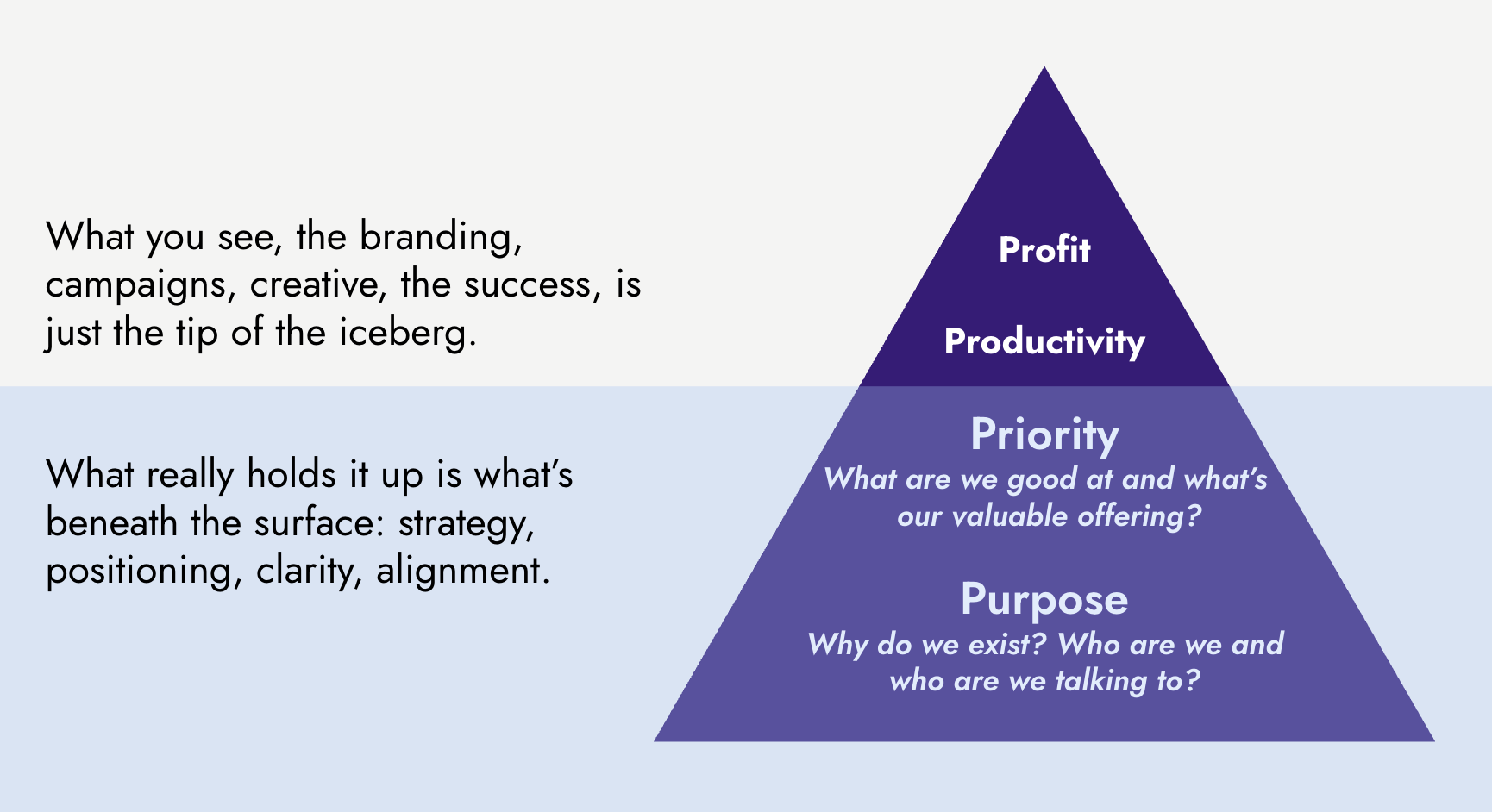
What losing the plot looks like and how brand strategy can be the antidote
Unclear positioning is a pattern I see when brands don't have purpose and priority locked. Take a non-alcoholic beverage that also has adaptogens: is it a cocktail replacement or a mood-support product? Both can be true in the formulation, but only one should be true in how the brand presents outwardly. Strategically picking a lane that aligns with your ideal customer is the starting point for everything else: your packaging, your website, the language you hand your sales team. That is the work brand strategy is supposed to do for you, and it is the foundation everything else gets built on.
Disconnected stakeholder priorities are just as common. The more voices a brand has in the room, the more easily the vision blurs. Creating a durable mission and vision statement is not a values exercise or an internal alignment activity. Its job is to make decisions simple when things get complicated: when the economy shifts, when the team grows, when the market moves. If you have to relitigate the vision every time conditions change, the vision is not working hard enough. A good strategist helps you build that center before the noise arrives, so you have something solid to come back to when it does.
Fragmented customer experience is another place I see it break down. For example, your packaging aesthetic and messaging are essential brand assets and should never be treated as an afterthought. You might end up at a convenience store, a pop-up inside a coffee shop, a trade show floor. In every one of those contexts, your brand needs to tell its story quickly (and who it's for!) and without your help. If it can only do that on your own website, where the context is already set, you have a gap worth closing. Brand strategy gives you the tools and the clarity to close gaps before it costs you a customer.
And the big one: "More is more." Being present, consistent, and close to your customer is a legitimate competitive move. You need to look alive online, on social, and in your industry conversations in a way that creates real momentum and impact. But trying to do everything at once before you have the strategic foundation to support it is how brands quickly lose the plot.
The brands I see overextend are usually doing several things at once: building out Instagram and TikTok, launching a Substack, prepping a trade show booth, adding an AI chat layer to the website, working on GEO strategy, optimizing Shopify, booking speaking appearances, pitching podcasts. Each of those is a defensible decision on its own. Together, without a strategic foundation or an order of operations underneath them, they are spinning plates. The energy goes into keeping things moving rather than actually building anything.
"More is more" messaging doesn't work either. The best brands are not out there trying to tell every story they possibly can. They have found one or two stories that are completely theirs and they tell them really well, over and over again, in ways that are entertaining enough that you never get tired of hearing it. This kind of consistency reads as confidence. It also gives you a filter for the noise, including every meme and trending audio moment that comes across your feed. Not every viral moment is yours to capitalize on, and chasing the ones that aren't is how you end up sounding performative. Strategy gives you the permission to say no, and that’s what protects the brand you are building.
What you actually get when you get clear
A clear strategy reflects where you are today and where you want to go tomorrow. It gives you the framework to know what is a full-body yes and what gets tabled. It is malleable enough to flex as market conditions, industry shifts, and the wider world change around it. And it sets you up to live and plan as if you are not going anywhere.
Clarity is what makes action motivating and exciting. It is the thing that gets you inspired to move faster, with less waste, and more impact. It is the difference between waking up knowing exactly what you are doing that day and why, and waking up already behind.
When I work with brands, the goal is finding your highest points of leverage and setting you up to take actions that actually create momentum. I love to slow down and get clear with you so everything after it moves faster. There is something powerful about knowing what to say yes to without your team having to talk itself into it every single time.

I have spent fifteen-plus years helping brands find their footing. I've seen them lose steam, scale beautifully, spin out, and do the hard work of getting clear and come out the other side with real momentum. I am a product of learning from what works, but most importantly what does not work.
It lights me up to share what I have learned from being someone who has worked in the trenches at every level of a marketing organization.
I run focused brand sprints that give you a short, medium, and long-term picture grounded in three things: your actual business problem, who you are in the market and why, and the highest-leverage moves available to you right now. You leave with clarity, a point of view, and a real order of operations.
If that sounds like where you are, I would love to chat!